
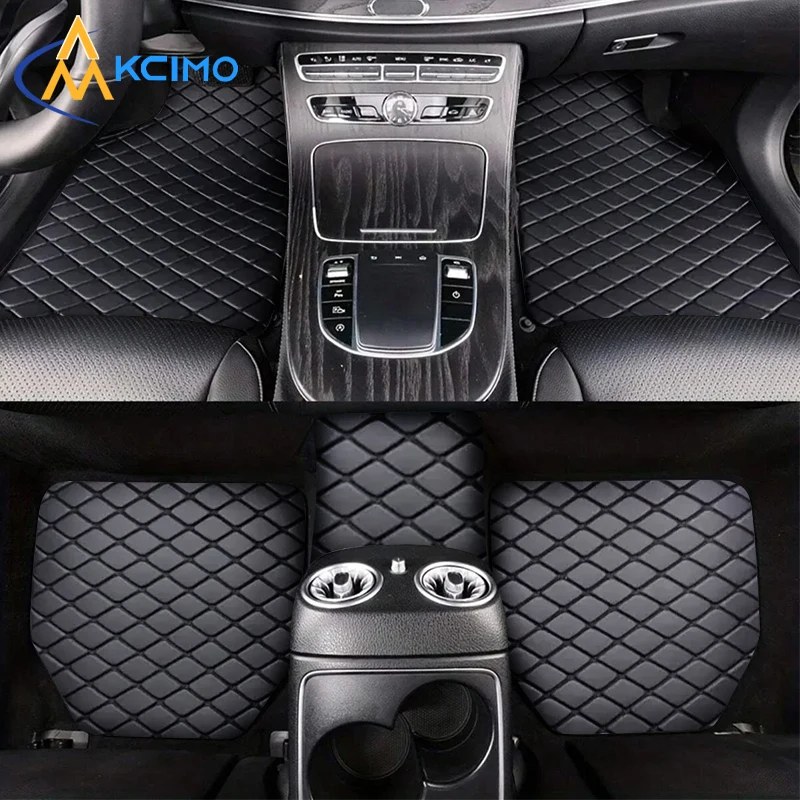
Floor mats are the hardest working item in a car interior and the cheapest to replace, which is exactly why it is worth getting them right. The carpet underneath is neither cheap nor easy to replace.
Rubber mats
Waterproof, easy to clean and the obvious choice for a British winter. A rubber mat with a raised lip holds water, slush and grit rather than letting it soak through into the carpet.
Downsides: they look utilitarian, cheap ones can smell in a hot car, and they are noisier underfoot.
Carpet mats
Better looking, quieter and warmer underfoot, and they match the interior. They absorb water rather than containing it, which is fine in summer and a problem from October onwards.
The sensible approach
Many people run two sets: carpet from roughly April to October, rubber from October to April. Mats are inexpensive enough that this is realistic, and swapping them takes a minute.
If you only want one set, rubber is the safer choice in the UK. Wet carpet under a mat is the single most common cause of a musty cabin.
The safety point
Whatever you choose, the mat must be secured. Most cars have floor clips or hooks; use them. An unsecured driver’s mat can slide forward and foul the pedals, and stacking a new mat on top of the original is a genuinely dangerous habit that has caused accidents.
- Use the car’s fixing points every time
- Never stack one mat on another
- Check the driver’s mat position after vacuuming
- Replace mats once the backing loses its grip
Measuring before you buy
Universal mats are sold in a few sizes and rarely fit well. A mat that is too large curls at the edges or rides up the transmission tunnel; one that is too small leaves carpet exposed exactly where the heel sits.
- Remove the existing mat and measure its widest and longest points
- Note the position of any fixing clips relative to a corner
- Check the shape of the driver’s mat, which is usually not symmetrical
- Measure the rear mats separately; they are often a different size
- For a one-piece rear mat, measure across the transmission tunnel
Heel pads and wear points
The driver’s mat wears out long before the others, and almost always in one spot where the heel pivots. A mat with a reinforced heel pad lasts substantially longer, and on carpet mats it is the single feature most worth paying for.
If a mat has worn through at the heel, replace it rather than leaving it. Once the backing is gone, grit passes straight through onto the carpet underneath, which is the thing the mat exists to protect.
Rubber mat smell, and how to deal with it
New rubber mats, particularly inexpensive ones, can smell strongly in a warm car. It is residual manufacturing compounds off-gassing, and it fades, but it can take weeks in a closed vehicle.
Speed it up by leaving the mats outside in a sheltered spot for a few days before fitting, and wash them with warm soapy water first. Mats that still smell strongly after a month are worth returning.
Frequently asked questions
How do I stop mats sliding forward?
Use the manufacturer’s clips. If the car has none, choose mats with a spiked rubber backing designed to grip carpet.
Can I pressure wash rubber mats?
Yes, and it is the quickest way to clean them. Let them dry fully before refitting or you have simply moved the water into the car.
